
Reader’s Choice : Letrozole & Endometriosis

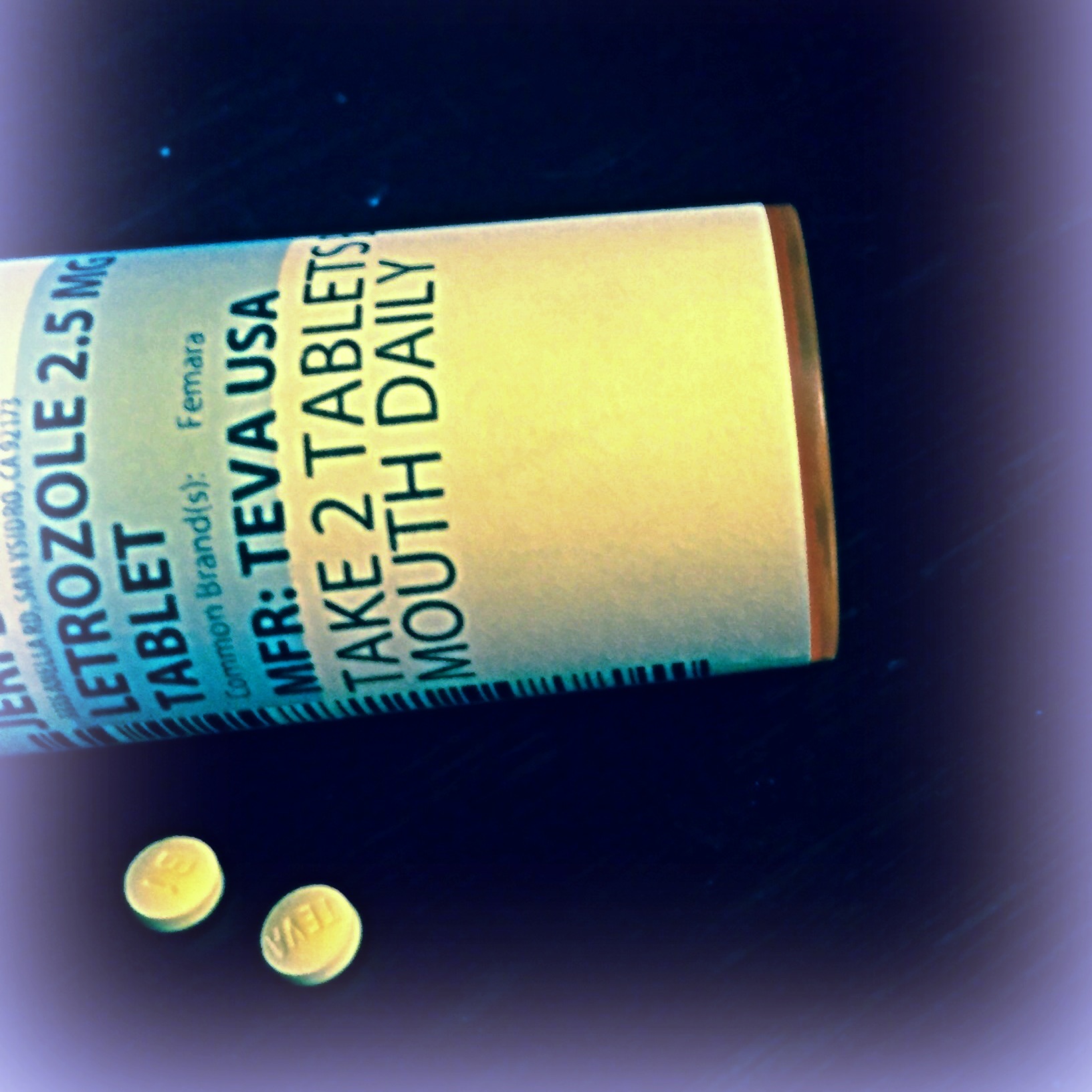
Bottle of Letrozole
Photo courtesy of JLD

One of my local EndoWarriors has started a new medication to help with her Endometriosis pain and symptoms, based upon the recommendation of her new physician.  It’s Letrozole, which I had never heard of.  And she asked me if I had any info on it…so…now I’m inspired to do some research!

What is Letrozole?

Letrozole is the generic name for Femara, a drug classified as an aromatase inhibitor.  What is aromatase?  It’s an enzyme that is crucial in the creation of estrogen. Aromatase inhibitors have been FDA approved for treating breast cancer in post-menopausal patients.  However, it has piqued the interest of the medical community in controlling Endometriosis symptoms.  It is not yet FDA approved for this treatment, but is used as an off-label, accepted treatment among the medical community. As of today’s research, there are no indications that drug manufacturers are going to seek FDA approval for aromatase inhibitors to treat Endometriosis.

Continue reading

Cataracts? …

Cataract

So today I had my two-year eye exam.  You know: you go in ever two years to have your eyes checked and your eyeglass prescription updated.

About 8 years ago I learned that I have a benign cataract in my left eye, located just to the outside of my pupil.  My doctor back then told me it’s benign, it doesn’t grow, it just sits there a casts a shadow.  However, it’s not visible to me, and it will never affect my eye sight.  She surmised I was born with it : it may be due to my premature birth (I was 3 1/2 months early) and have likely had it my entire life.  Every two years since, I’d been told by the next doctor that I had a benign cataract on my left eye, and that it was just sitting there, doing nothing.

Continue reading

So…this just happened…

download

Two weeks ago a paper was published in the Acta Veterinaria Scandinavica journal.  The first reported case of an Endometrioma in a dog.  A German Shepherd, to be precise.  Now don’t be too surprised; primates have been found to develope endometriosis: gorillas, monkeys, and baboons.  But this is the first time captured in literature that an animal has developed an Endometrioma.  What’s that?  A blood-filled cyst consistent with Endometriosis, sometimes referred to as a Chocolate Cyst.

Continue reading

Reader’s Choice : C-Sections & Endometriosis

A friend asked me to look up any connections between Endometriosis and Cesarean Sections.  So, here we go.  Lots of science in this one!  Some studies show that less than 1% of women who undergo a cesarean section end up developing incisional Endometriosis (Endometriosis in or along the c-section scar).  However, that tiny little 1% number has a staggering amount of studies involving a lot of women who suffer from this form of Endo.

Continue reading

New Pill? Viagra for Women!

A hand holding a small pink pill
(This post was originally published on June 8, 2015.  As of April 19, 2018, it was updated to include new information)

In 2015, the FDA advisory committee was pushing for the approval of a new drug, Addyi (aka flibanserin), which is being hailed as “viagra for women.”  The drug was approved on August 18, 2015. Many women suffer from a low sex drive for many different reasons.  I myself had suffered with it since my Lupron Depot injections, which were immediately followed by a continuous birth control.  My libido was nearly non-existent for almost two years.  Since I stopped taking birth control pills, however, it returned full-force!

But what is this drug? What are the potential side effects? How long were the clinical trials?  All of these questions come running to the tip of my tongue – will the pros outweigh the cons?  Will there be interactions with my birth control pill?  Less questions, MORE RESEARCH!

Continue reading

Endometriosis & the Brain

Krang from Teenage Mutant Ninja Turtles
Krang, from TMNT, seemed appropriate for this one…

Another rare location I’ve heard can be invaded by Endometriosis is our brain. Yep.  Our gray matter.  But, again, curiosity led me to find documented cases, symptoms, and treatments. So I’ve scoured the interwebs for just such a thing, but it was difficult to find much of anything!  This is not meant to scare anyone, or to create an Army of Hypochondriacs.  It’s meant to let everyone know that, yes, it does happen.  And this is what to look for…and what can be done for it..

From what I can find (which was very, very little), it appears that symptoms may include headaches or seizures.  As of 2010, there have only been 3 documented cases of cerebral Endometriosis (at least in English-language literature).

Let’s get down to the nitty gritty science!

Continue reading

Endometriosis & Soy Products

Bowl of soy beans in the pod

Here we go again, inspired to write due to a dietary “restriction.”  I’ve read that as an Endo Sufferer, I should avoid (or drastically cut back from) soy and soy-based products.  I’ve read soy mimics and increases estrogen levels, which we’ve come to understand can affect our Endometriosis growth and symptoms.  So today, I want to do my own research.

Soy products are the “richest sources of isoflavones” that humans can eat.  What the heck is an isoflavone? It’s a “plant-based compound with estrogenic activity” English, Lisa, ENGLISH! It means it’s a plant-based compound that mimics estrogen.  So, soy has a very rich, or high levels, of a property, a compound, a thing…that acts like, or mimics, estrogen.  The isoflavones can attach themselves to estrogen receptors throughout the body, and either mimic or block certain estrogen effects in tissues.

Why is that bad? Well, it’s not, for everyone.  Estrogen may help prevent certain forms of cancer (breast, uterine, or prostrate), stimulate bone growth, or help women suffering with post-menopausal symptoms. But for those of us who suffer from what very-well may be an estrogen-driven disease, it can be very bad.

Continue reading

Reader’s Choice : Can Men Get Endometriosis?

Male symbol

Last night, my boyfriend and I were talking about Endo’s “weirdness” how it can pop up in strange and unheard of places, and he popped the question (no, not THE question…), “Are there any reports of men having Endometriosis?”  I remembered reading somewhere that there were a few rare cases of it, but hadn’t read them deeply enough to understand their situations, diagnoses, and prognoses.  So, we have our topic for today!!

In rare cases, cis-men develop Endometriosis.  Transmen also suffer from the disease. But we will focus on cis-men for this blog: it appears many have been treated with long-term or large doses of estrogen therapy, but some are healthy men who have no history of cancer or estrogen treatment.  Here’s what I could find:

Continue reading

Endometriosis on your skin

Diagram of human skin

It’s about time I research more about Endometriosis being found in places other than your pelvic region.  We’ve already covered lungs, spine, and eyes, and today we’re going to delve into cases of Endometriosis and skin.  Skin? Yes, skin.  I’ve read that it’s rare, just like the other areas outside of the pelvic cavity…but, it does occur.  Some theorize it is implanted via the lymphatic orpro vascular systems; others think the cells are transplanted via surgery.

There seem to be two common categories of Endometriosis and the skin : spontaneous Endometriosis and scar Endometriosis.  Spontaneous Endo simply appears in random places on healthy skin (cutaneous or subcutaneous).  Scar Endo is found within scar tissue from prior surgeries or injuries.  It appears that surgical excision/removal of the Endometriosis lesions from the skin is the most common and effective way of handling the lesions.  Some surgeries may leave defects, which may (or may not) be repaired or rebuilt with a surgical mesh.  Some studies suggest that hormonal treatment may be too harsh for the patient for solitary lesions.

Continue reading